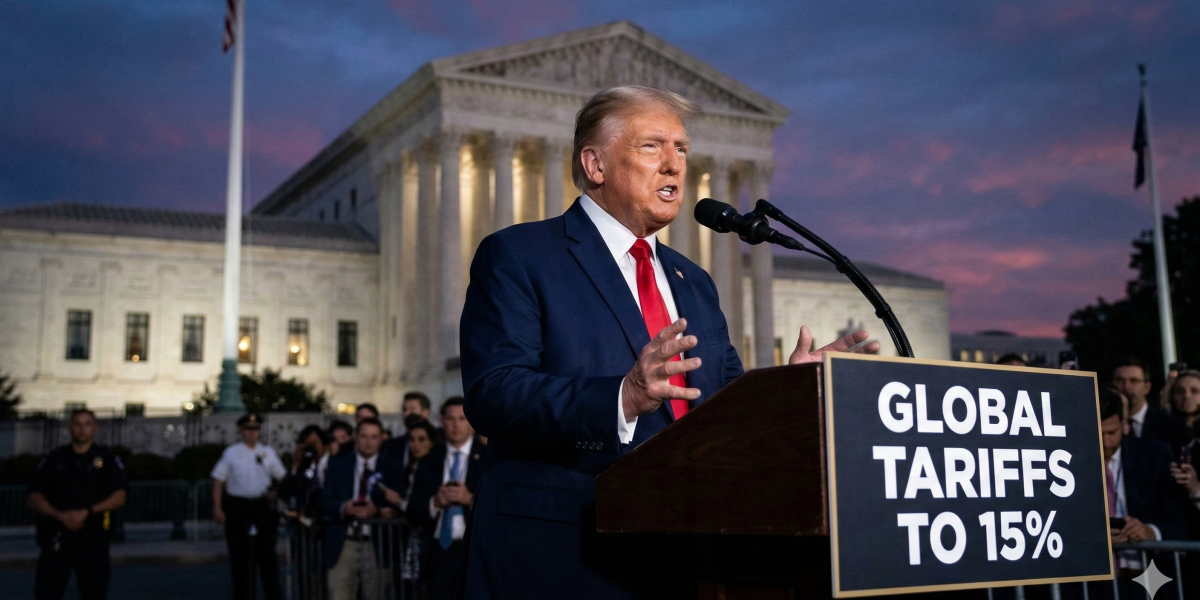
Trump Raises Global Tariffs to 15% After Supreme Court Setback
Just when markets thought they had a handle on the tariff situation, President Donald Trump reshuffled the deck again.
One day after the Supreme Court struck down his “reciprocal” tariffs in a 6-3 ruling, Trump took to Truth Social on Saturday to announce he’s raising global tariffs from 10% to 15% — effective immediately. The move signals that despite the legal setback, the administration has no intention of retreating from its aggressive trade posture.
“I, as President of the United States of America, will be, effective immediately, raising the 10% Worldwide Tariff on Countries, many of which have been ‘ripping’ the U.S. off for decades,” Trump wrote, adding that more tariffs are coming in the “next short number of months.”
What Led Here
The backstory matters. On Friday, the Supreme Court ruled that Trump had wrongfully invoked the International Emergency Economic Powers Act (IEEPA) as the legal basis for his sweeping tariff agenda. Rather than stand down, Trump pivoted the same day — announcing a 10% global tariff anchored in a different legal framework: Section 122 of the Trade Act of 1974.
Then, less than 24 hours later, that 10% became 15%.
Section 122 does allow the president to impose temporary trade levies, but there’s a catch — any extension beyond the initial period requires Congressional approval. That’s a political hurdle that could limit how long these tariffs actually hold.
Some Uncertainty Remains
Despite the “effective immediately” language, it’s not entirely clear whether the formal paperwork has been signed or when exactly the tariffs kick in. A White House fact sheet issued Friday had pegged the original 10% tariffs to begin Tuesday, February 24th at 12:01 a.m. ET — which also happens to be the same day Trump is scheduled to deliver his State of the Union address to Congress. Convenient timing, to say the least.
The White House has not issued further clarification on the updated timeline.
What This Means for Markets
Investors should treat this as an evolving situation, not a settled one. The legal landscape around these tariffs remains contested, and the administration’s willingness to layer new levies on top of a fresh legal challenge suggests we haven’t seen the final chapter of this trade policy saga.
Sectors with significant import exposure — think consumer electronics, retail, manufacturing inputs — will be watching Tuesday closely. And with Trump hinting at additional tariff announcements in the coming months, the uncertainty premium isn’t going away anytime soon.
The bottom line: the tariff story is far from over. Stay tuned.

About akchirpy
Contributor at WallStreetPR.